

What if the secret to a successful first harvest isn't more equipment, but less? If you've spent any time on mushroom forums lately, you've likely seen the heated debate of all in one grow kit vs monotub. It's easy to feel overwhelmed by conflicting advice and the fear of wasting your hard-earned money on a setup that fails. You want a reliable harvest without turning your apartment into a high-tech lab or dealing with a massive mess. We understand that frustration because we've been there too.
This guide will help you cut through the noise and find the method that actually fits your space and experience level. We'll break down the key differences between these two popular approaches so you can choose with confidence. You'll discover how a compact 5lb all-in-one kit offers a low-risk, high-reward entry point for beginners. We'll also look at how sterile grain bags and bulk substrates allow you to scale up to larger tubs when you're ready for more volume. By the end, you'll know exactly which path leads to your first successful flush with minimal maintenance.
Key Takeaways
- Understand the "micro-universe" concept and why it makes all-in-one kits the perfect low-risk entry point for new growers.
- Compare the all in one grow kit vs monotub to decide if you prefer the simplicity of a bag or the higher yields of a larger tub.
- Learn why a 5lb grow kit provides the ideal balance of volume and success for those with limited apartment space or busy schedules.
- Discover how to use sterile grain bags and mushroom supplements to scale your hobby from a single bag to a high-output system.
Understanding the Basics: AIO Kits and Monotubs Explained
2026 is the year of accessible mycology. Home gardeners are discovering that growing mushrooms is just as rewarding as growing tomatoes. The hobby has moved from specialized labs to kitchen counters. When you start, your first big choice is the all in one grow kit vs monotub. Understanding the basics of Fungiculture is the first step toward a successful harvest. The core difference between these methods is how the grain and substrate are handled. One is an integrated "micro-universe" where layers exist in one bag, while the other is a more hands-on approach where components are kept separate until the final mix.
Think of an All-In-One (AIO) bag as a "micro-universe." Everything your mushrooms need to thrive is already inside. This setup is perfect for hobbyists who want a successful first harvest without buying a room full of gear. It simplifies the process by keeping the nutrition (grain) and the moisture-holding material (substrate) in a single, sterile environment.
The "No-Transfer" Advantage of AIO Bags
Staying in one bag is a game changer. Most mistakes happen when moving materials from one container to another. With a 5lb All-In-One kit, the entire lifecycle happens in one place. You simply inject your culture through a self-healing injection port (SHIP). This specialized rubber port seals itself immediately, keeping the inside protected. A built-in filter patch manages fresh air exchange automatically. This means you don't need to fan the bag or mist it constantly. It's the ultimate low-maintenance path to success for those with busy schedules.
The Monotub: A Step Toward Volume
A monotub acts like a "mini-greenhouse." It's typically a large plastic bin with specific holes for airflow. This method is great if you want a massive harvest, but it requires more work. You have to manage two distinct stages: colonization and fruiting. This involves a process called "S2B," or Spawn to Bulk. In this stage, you take your colonized grain and mix it into a larger bed of substrate inside the tub. This creates a massive surface area for mushrooms to grow. It's a step toward volume that rewards growers who have a little more time and space to spare. While it's more complex than a bag, it offers the highest yields for the dedicated hobbyist.
AIO Kits vs. Monotubs: Comparing Effort, Yield, and Complexity
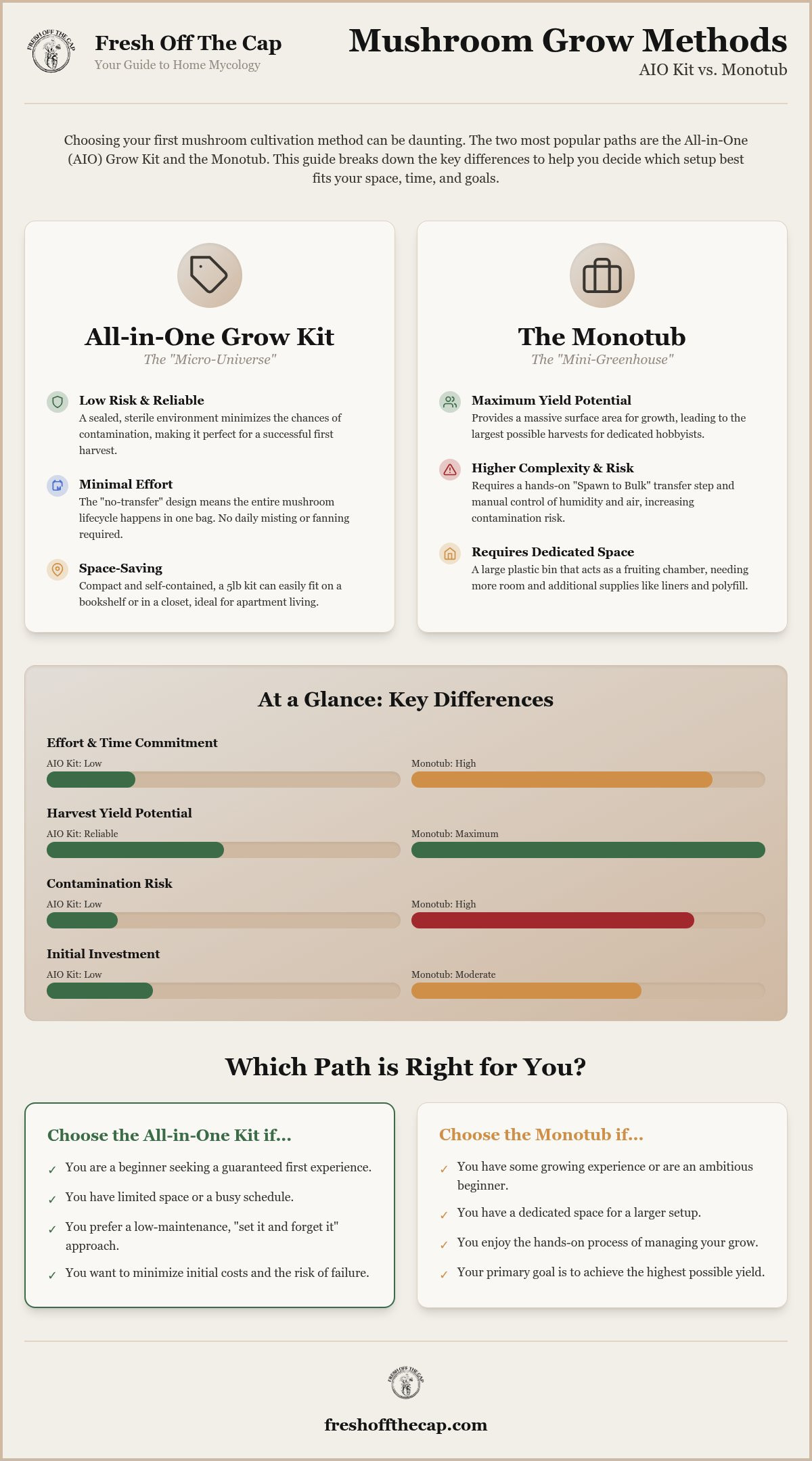
Choosing between an all in one grow kit vs monotub often comes down to how much time you want to spend in your garden. Monotubs are the heavy lifters of the hobby. They offer massive yields but demand a dedicated space and daily attention. On the other hand, a 5lb AIO kit is often the sweet spot for hobbyists. It fits on a small bookshelf and requires almost zero active time once inoculated.
According to the Beginner's Guide to Growing Mushrooms, environmental control is the biggest hurdle for new growers. Monotubs require you to manually balance humidity and fresh air. If your schedule is packed, an AIO bag is much more forgiving. It manages its own atmosphere, whereas a tub might dry out or become stagnant if you miss a day of misting.
Yield vs. Reliability: The Great Debate
When comparing the all in one grow kit vs monotub for reliability, look at the failure margin. Experienced growers talk about "biological efficiency," which is the ratio of fresh mushrooms to the dry weight of the substrate. While monotubs have a higher ceiling for total weight, they also have a higher risk. If contamination enters a large tub, you lose the entire project. In contrast, an AIO bag is a sealed unit. You can still get multiple "flushes," or harvest cycles, from a single bag by simply rehydrating the block after the first pick.
Initial Investment and Recurring Costs
Testing the waters shouldn't break the bank. AIO kits are the most cost-effective entry point because they include everything in one price. Monotubs seem cheap until you factor in the hidden costs. You'll need liners to prevent side-pins (mushrooms that grow awkwardly against the plastic walls), polyfill or foam for air holes, and quality misting tools. When you calculate the price per pound of substrate, the AIO kit wins for simplicity and upfront value. If you're ready to start your journey without the clutter of extra gear, check out our professional-grade supplies to see which setup fits your budget.
Choosing Your Path: Which Method Matches Your Growing Goals?
Your lifestyle is the biggest factor when weighing an all in one grow kit vs monotub. If you live in a small apartment or a studio, space is a luxury. You probably don't want a large plastic bin taking up your only closet or sitting in the middle of your living room. The University of Florida IFAS Extension explains the basics of mushroom cultivation as a balance between biology and environment. For urban dwellers, a bag is a self-contained unit that fits into your life without requiring a renovation.
Lifestyle Factors: Time and Attention
Think about your daily routine. Are you a "Weekend Mycologist" with a packed schedule? AIO kits follow a "set and forget" philosophy. Once you inoculate the bag, you can mostly step back and let nature work. Monotubs, however, offer a "hands-on" mentorship experience. They require daily check-ins to monitor moisture and air quality. If you enjoy the process of fine-tuning your environment every morning, a tub is rewarding. If you just want a successful harvest with minimal fuss, stick with the bag.
Environmental Control at Home
Indoor air can be tricky, especially in the winter. Forced-air heating often creates a very dry environment that can stall a mushroom grow. Bags protect your mycelium from these fluctuations by trapping humidity inside. If you're using a tub, you might need a humidifier or constant misting to keep things right. You should also consider which species you want to grow. Some varieties prefer the side-fruiting style of a bag, while others thrive on the flat surface of a tub. If you want to see what's possible in a small space, Explore our Gourmet Grow Kits to find a species that fits your home.
When you're ready to scale up, you don't have to abandon what you've learned. Many growers start with bags to master the stages of fungal growth before moving to bulk substrates and sterile grain bags. This progression builds your confidence and ensures you don't waste money on a large, failed tub. Ready to take the first step? Pick up one of our All-In-One Grow Kits and start your first harvest today.
Success Strategies: Transitioning from Beginner to Expert Grower
The journey from a first-time grower to a seasoned mycologist is a natural progression. You don't need to rush into complex setups to see great results. Instead, focus on mastering the basics of observation. Most growers find that starting with a 5lb bag is the smartest move. It allows you to learn the fungal lifecycle in a controlled environment. Once you understand how the mycelium behaves, the choice of all in one grow kit vs monotub becomes much clearer based on your personal goals.
As you gain confidence, you can start boosting your efficiency. This is the perfect time to experiment with mushroom supplements to increase your biological efficiency and speed up colonization times. When you're ready for larger volumes, you can transition to using sterile grain bags to create your own bulk spawn for a monotub. A helpful tip from our team: always keep a log of your grow dates. Tracking when you inoculated and when the first pins appeared will help you predict future harvests with pinpoint accuracy.
Identifying Healthy Growth
Learning to read your mycelium is an essential skill. Look for the "White Cloud" test. Healthy mycelium should look like bright white, fluffy clouds spreading through the grain. Occasionally, you might see small droplets of yellow or orange liquid. This is often called "mycelium piss," but it's actually just metabolites. It's a sign that the fungus is active, not necessarily contaminated. When the bag is about 30% white, perform a "Break and Shake." Gently break up the colonized grain and mix it with the rest of the bag to speed up the process. This simple step can shave days off your wait time.
Leveling Up Your Mycology Education
If you want to move beyond the basics, start exploring agar plates and liquid cultures. Agar plates allow you to isolate clean, strong genetics before you ever touch a grain bag. This ensures that every project starts with the best possible foundation. Liquid cultures offer a faster way to jumpstart either method, whether you're sticking with a bag or moving to a tub. These tools remove the guesswork and give you consistent, professional results every time. When you're ready to gather your gear, shop all Fresh Off The Cap supplies to start your next grow with confidence.
Ready to Start Your First Harvest?
Deciding between an all in one grow kit vs monotub doesn't have to be a stressful choice. If you're looking for a low-risk entry point that fits into a busy lifestyle or a small apartment, the all-in-one bag is your best friend. It provides a sealed "micro-universe" that protects your project from common errors while you learn the fungal lifecycle. For those ready to manage larger volumes and more complex environmental controls, the monotub offers a rewarding way to scale your hobby.
Fresh Off The Cap is here to be your partner in this journey. Our supplies are professionally sterilized in commercial autoclaves to give you the best chance of success from day one. We offer comprehensive support for growers nationwide and are trusted by beginners and experts alike. You can grow with confidence knowing you have professional-grade tools and a supportive community in your corner. Start your low-stress grow with a Fresh Off The Cap All-In-One Kit and experience the joy of your first successful flush. You've got this!
Frequently Asked Questions
How long does an all in one mushroom grow kit take compared to a monotub?
When comparing the speed of an all in one grow kit vs monotub, you'll find both typically take 4 to 8 weeks to harvest. The bag method often feels more streamlined because it's a single-stage process. In a monotub, you must wait for grain to colonize before mixing it with bulk substrate in a separate bin. AIO kits remove this extra step, allowing the entire lifecycle to occur in one container with less active downtime.
Can I put an all in one grow bag inside a monotub?
Yes, you can place a grow bag inside a monotub to use it as a humidity tent. Once the bag is fully colonized and ready to fruit, opening the top and setting it inside a tub helps maintain a stable environment. This hybrid approach combines the safety of the bag with the consistent airflow of a larger chamber. However, it's not a requirement, as our kits are designed to succeed as standalone units.
Which method has a higher risk of contamination?
Monotubs generally carry a higher risk of contamination because they require more "open air" time during the mixing process. When you weigh the all in one grow kit vs monotub, the bag is significantly safer for new growers. Since the bag stays sealed from inoculation until the mushrooms fruit, there are fewer chances for outside bacteria to enter. This closed system is why we recommend kits as a low-risk starting point for hobbyists.
What is the best mushroom species for a beginner to grow in a bag?
Oyster mushrooms and Lion's Mane are fantastic options for anyone starting with a grow bag. These varieties are known for being resilient and fast-growing, making them very forgiving for beginners. They adapt well to the internal environment of the bag and produce beautiful clusters with minimal effort. We provide professional-grade liquid cultures and spores to help you succeed with these species, ensuring you get high-quality genetics for your very first project.
How many pounds of mushrooms can I expect from a 5lb AIO kit?
A 5lb kit typically yields several ounces to over a pound of fresh mushrooms across multiple flushes. While a monotub can produce significantly more, the bag method is much more consistent for those just starting out. The total yield depends on the genetics you use and how well you maintain humidity after the first harvest. For most home growers, a single 5lb bag provides a generous supply of fresh produce without the need for bulk storage.
Do I need special lighting for my grow bag or monotub?
Mushrooms don't need intense specialized lighting because they don't photosynthesize like plants. Indirect sunlight from a nearby window is usually enough for both grow bags and monotubs. If you're growing in a dark space, a simple low-wattage LED bulb on a 12-hour timer works perfectly. Light primarily acts as a compass, telling the mushrooms which way to grow and when it's time to start forming pins, the first stage of mushroom caps.

Article by
Joseph Rodriguez
Joseph is the founder of Fresh Off The Cap and a self-taught mycologist with over a decade of experience in mushroom cultivation and research. Formerly a music teacher, Joe transitioned his passion for harmony into the fungi kingdom, focusing on sharing knowledge and culture through mushroom wellness. His expertise led him to guest lecture for the Psychedelic Anthropology course at CU Denver. To deepen his practice, Joe studied under Dr. Joe Tafur and completed The River Course, focusing on an integrative approach to psychedelic therapies and sacred plant medicine. Today, he channels this holistic framework into expanding fungal literacy and community wellness.
Disclaimer
The information provided in this article is for educational and informational purposes only. It is not intended as medical advice, diagnosis, or treatment. Please consult with a qualified healthcare professional before making any changes to your diet, supplement regimen, or lifestyle routines.